







Best Lightweight Sleep Tracker for Women (2026): Why Weight Matters More Than Another Sensor
Looking for the best lightweight sleep tracker for women? Discover what to consider in comfort, design, battery life, and sleep monitoring features, and explore how FANY Luna helps you understand your sleep patterns.
If you have ever taken your sleep tracker off at 2 a.m. because it felt like a brick strapped to your wrist, you already understand the central problem with sleep tracking: the best sleep data in the world is useless if you stop wearing the device.
Most full-size smartwatches weigh 50 grams or more. That is fine at the gym. It is a different proposition when the same device spends eight hours pressed between your wrist and a pillow.
This guide covers why overnight weight, band material, and battery life determine whether a sleep tracker produces usable data at all, what to look for when you shop, and how the FANY Luna—29.2 g with the silicone band, 23.9 g with the leather band—is engineered around those specific failure points.
Why most women abandon their sleep tracker by week three
The pattern is remarkably consistent. You buy a tracker to understand your sleep. For the first few nights you wear it. Then:
- Night 4: You wake up, your wrist itches, you loosen the band—and the heart-rate sensor starts losing contact.
- Night 7: You take it off to charge it and forget to put it back on.
- Night 12: You stop wearing it during the week and only wear it "when you remember."
By week three, you have a dataset full of holes, and the trend line—the only part that actually means anything—is useless.
Women tend to hit this wall earlier than men, for three reasons that have nothing to do with willpower:
- Wrist circumference. A device body designed for a large wrist sits proportionally taller and catches on sleeves, cuffs, and pillow edges more often on a smaller wrist.
- Skin reactivity. The Sleep Foundation notes that women report sleep problems more often than men overall—which means women are disproportionately the people trying to track a problem night after night, on skin that has to tolerate 8 hours of occlusion.
- Device expectations. Most mainstream sports watches are built around daytime workouts, GPS, and notifications. "Comfortable enough to sleep in" is usually an afterthought, not a design constraint.
The result is a specific kind of frustrating purchase: you paid for insight, and what you got was a gadget that broke your sleep and then stopped collecting data.
What actually happens when you wear a 50 g watch to bed
Sleep is not a shutdown state. Your body cycles through light sleep, deep sleep, and REM roughly every 90 minutes, and during REM your brain is highly active while your muscles are temporarily paralyzed. That combination matters here: you are neurologically sensitive to sensory input at exactly the moment you are least able to shift position to relieve it.
Three mechanical problems follow from strapping a heavy device to that wrist.
|
Failure mode |
What's happening |
What you actually feel |
What it does to your data |
|
Sustained pressure |
The watch body presses into the wrist and the ulnar side through the night, especially in side-sleeping positions. |
Wrist ache, numbness, "I need to take this off" at 3 a.m. |
Skin indentation can irritate tissue and degrade optical sensor contact |
|
Bedding friction |
A tall case profile catches on sheets, duvets, and pyjama cuffs. |
You wake when you turn over; the watch shifts position. |
Motion artefacts register as wake events, inflating "restless" scores |
|
Occlusion and sweat |
A non-breathable band traps moisture against skin for 8+ hours. |
Itching, redness, a rash that appears after a week of consistent wear |
You stop wearing it — which ends data collection entirely |
There is also a direct measurement consequence. Optical heart-rate sensors need consistent skin contact to derive heart rate variability (HRV), and HRV is what most sleep-staging algorithms lean on. Too loose and the sensor reads ambient light and motion instead of your pulse. Too tight and you get local pressure, which is exactly what you are trying to avoid. Getting both at once is a hardware design problem, not a willpower problem—and it is much easier to solve when the device is light.
Does device weight really change sleep data? An honest answer
Let us be precise, because this claim is often oversold.
What is well supported: Comfort determines whether you wear a device consistently, and consistent wear determines whether you have a usable longitudinal dataset. Comfort is influenced by mass, case profile, band material, and strap design.
What is not well supported by published evidence: the claim that a device must be under some specific weight for HRV readings to be valid. There is no widely cited threshold study establishing that. What we can say honestly is that a heavy device increases the chance of pressure, movement, and skin irritation—and each of those can degrade sensor contact and signal quality. The effect on data is real, but it is indirect, and it varies by person.
We would rather tell you that than pretend a gram threshold is a scientific fact. If a competitor claims otherwise, ask for the citation.
The 5-point checklist: how to choose a sleep tracker you'll actually wear
Use this whether you buy a FANY Luna or anything else.
- Total worn weight under ~30 g. Ask for the weight of the whole device—case plus band—not just the case. Manufacturers quote case-only weight surprisingly often.
- Low-profile case. Under 11 mm is a reasonable target. Height matters more than width for catching on bedding.
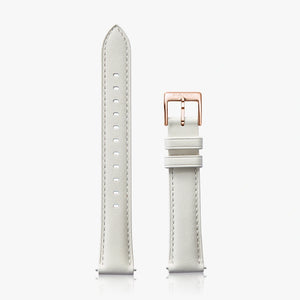
- A band material you can tolerate for 8 hours. Medical-grade liquid silicone and full-grain leather both breathe better than cheap TPU. If you have a known nickel or adhesive sensitivity, check the hardware and the band coating, not just the strap.
- Battery life of 5+ days. Anything that needs nightly charging will produce gaps in your data. This is the single most underrated spec in sleep tracking.
- Data you can export. Trends over 8–12 weeks are the point. If your data is locked in an app with no export and no history view, you cannot do the analysis that justifies wearing the thing.
FANY Luna: how it maps to each failure point
FANY built the Luna specifically for overnight wear rather than adapting a sports watch, and the design choices line up with the checklist above.
|
Spec |
FANY Luna |
Why it matters overnight |
|
Weight—silicone band |
29.2 g |
Under the ~30 g target for all-night wear |
|
Weight—leather band |
23.9 g |
Lightest configuration; leather also flexes rather than snagging. |
|
Band material |
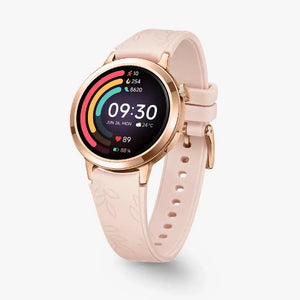
Medical-grade liquid silicone; full-grain leather option |
Lower irritation risk than low-cost synthetic TPU; easier to keep clean |
|
Band texture |
Embossed olive-leaf pattern |
Creates micro-air gaps so sweat is not sealed against skin |
|
Battery life |
Up to 10 days |
Six nights of continuous data between charges, not one |
|
Sleep metrics |
Sleep stages (deep / light / REM), awakenings, sleep score |
Answers: "Am I actually getting deep sleep?" |
|
Continuous metrics |
HRV, resting heart rate, blood oxygen |
Trend lines for stress and recovery |
|
Women's health |
Cycle tracking and prediction, resting HR by cycle phase |
Context that a generic fitness watch does not provide |
How each spec addresses the three failure modes:
- Pressure: at 23.9–29.2 g with a low-profile case, there is far less mass pressing into the wrist in a side-sleeping position.
- Friction: The reduced case height and a flexible leather option mean less to catch on to sheets and cuffs when you turn over.
- Occlusion: Medical-grade silicone plus an embossed texture instead of a flat, sealed strap reduces the moisture trap that causes the week-two rash.
- Gaps: 7-day battery life removes the nightly "take it off to charge" step that quietly destroys most people's datasets.
What the data actually tells you (and what it doesn't)
Sleep architecture
You get a breakdown of time in deep, light, and REM sleep, plus recorded awakenings. Typical ranges reported in sleep medicine literature put deep sleep roughly in the 13–23% band and REM around 20–25% of total sleep time, varying with age—treat those as orientation, not targets to hit. The useful questions are comparative:
- Am I spending less time in deep sleep this month than last month?
- Am I waking at 3 a.m. consistently, or was it one bad night?
- What changed on the days my sleep score dropped—late training, alcohol, a stressful deadline, a different shift pattern?
HRV and recovery
Continuous HRV tracking gives you a daily autonomic readout. In practice, most users see:
- HRV trending down during sustained work stress, poor sleep, or illness
- HRV trending up when training load is well managed and recovery is adequate
- Resting heart rate drifting down over weeks as aerobic fitness improves
The value is in the slope, not the nightly number. One low reading means nothing. A week of low readings means something.
Women's health features
FANY Luna adds predictive cycle tracking, resting heart rate analytics, and blood oxygen monitoring. This is the part that generic fitness watches handle poorly, and it is why a purpose-built tracker makes sense for a lot of women: sleep, resting HR, and cycle phase interact, and seeing them on one timeline is more useful than seeing them in three separate apps.

Related reading: Why Do Women Suffer More from Insomnia? A Data-Driven Sleep Tracking Perspective — how hormonal phases show up in sleep and HRV data.
Who the FANY Luna is for—and who should skip it
Buy it if:
- You have stopped wearing your current tracker because it is uncomfortable at night
- You have a small wrist, and full-size watches feel oversized
- You react to cheap synthetic bands and need medical-grade silicone or leather
- You want cycle-aware sleep and recovery data in one place
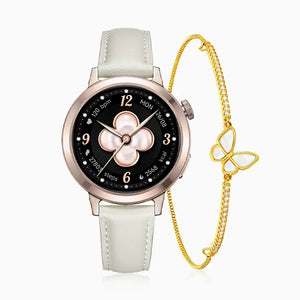
- You want a watch that looks like jewelry rather than gym equipment
Skip it if:
- You want advanced training load, GPS routing, or third-party sports app ecosystems—this is a wellness tracker, not a multisport watch
- You need clinically validated sleep staging for a diagnosed sleep disorder. No consumer wearable replaces polysomnography; talk to a clinician about a sleep study
- You expect to read notifications and use apps on your wrist all day — the battery life figure assumes sleep and health tracking as the primary use
FAQ
Is it bad to wear a smartwatch to bed?
Not inherently. The problems come from three specific things: sustained pressure on the wrist, friction against bedding, and sweat trapped under a non-breathable band. A light device with a breathable band largely avoids all three. If you regularly wake with wrist marks or itching, your current device is too heavy or the band does not suit you.
How heavy is too heavy for a sleep tracker?
There is no clinically established threshold. As a practical shopping guideline, look for a total worn weight (case plus band) under about 30 g and a case height under about 11 mm. For reference, the FANY Luna is 29.2 g with the silicone band and 23.9 g with the leather band.
Do sleep trackers measure deep sleep accurately?
They estimate it. Consumer wearables infer stages from movement, heart rate and HRV, while a sleep lab measures brain activity directly. Directionally useful for tracking your own trends over weeks; not accurate enough to diagnose a sleep disorder.
Can a watch band cause contact dermatitis?
Yes. Prolonged occlusion with trapped sweat is a well-recognised cause of irritant contact dermatitis, and some people react to specific metals or additives in low-cost synthetic straps. If you develop a persistent rash, remove the device, let the skin recover, and switch band material before resuming. See a clinician if it does not settle.
Why does battery life matter so much for sleep tracking?
Because sleep insight comes from trends across weeks and months, not single nights. A device that needs nightly charging gets removed nightly, and every removal is a gap. A 7-day battery turns 30 nights of data into 26 nights instead of 8.
I have sensitive skin — what should I look for?
Medical-grade or platinum-cured silicone, or full-grain leather, with a textured rather than flat inner surface. Avoid unknown TPU blends. Wear it slightly loose during the day, clean the band weekly, and let your wrist dry fully before putting it back on.
The bottom line
Do not trade comfort for data, because you will end up with neither. The first step to better sleep insight is a tracker you forget you are wearing by the time you fall asleep.
With a 29.2 g silicone or 23.9 g leather configuration, medical-grade skin-friendly materials, a 10-day battery and dedicated sleep, HRV and cycle tracking, the FANY Luna is built around the specific reasons women take their trackers off at night.
 Sia Cooper


A nurse-turned-personal trainer and founder of Diary of a Fit Mom, Sia lost 45 lbs through clean eating and lifestyle changes—and has been helping women do the same ever since. Drawing on her own journey through pregnancy, motherhood, and IVF, she's passionate about making fitness feel approachable, realistic, and empowering for women at every stage of life. Your trainer and friend.