



What Do Smartwatch Numbers Mean? A Guide to Heart Rate, Sleep, Steps and Activity Data
Confused by smartwatch numbers? Learn what heart rate, steps, calories, sleep stages and activity data mean—and how to read your trends over time.
Your smartwatch may display a variety of data every day: heart rate, step count, calories burned, sleep stages, exercise duration, and more. But what do these numbers actually mean?
The best way to interpret smartwatch data is by observing long-term trends rather than judging your health or fitness based on isolated readings. A single day with an elevated heart rate, lower sleep score, or fewer steps doesn't necessarily indicate a problem with your body.
This guide will explain common smartwatch metrics and their meanings, describe how consumer-grade wearables estimate these values, and offer guidance on how to incorporate this information into your daily health management.
Topics covered in this guide:
- What heart rate data reveals
- How step count and calorie estimates are calculated
- The meaning behind sleep stage data from smartwatches
- Why trend analysis is usually more informative than individual readings
- Understanding the limitations of consumer health data
What Do These Numbers Really Mean?
Most people don't buy a women's smartwatch or a women's smartwatch because they need more data. They do it to better understand their daily routines. Do they exercise consistently? Sleep patterns have changed? Has their sleep changed?
This guide explains the health and activity metrics that are commonly displayed on a smartwatch. These include heart rate, sleep duration, REM, waking time, steps, and calories. This guide explains how to use these numbers in order to monitor daily trends, rather than focusing on one result.
What Does Smartwatch Health Tracking Actually Measure?
Smartwatches, fitness trackers, and other devices that record data use optical sensors, motion detectors, and algorithms. Smartwatch health tracking metrics that are commonly used include heart rate and steps.
|
Smartwatch Data |
What it represents |
What It Does Most Usefully |
|
Heart Rate |
BPM is also known as beats per minute. |
Observing the changes during rest, exercise, and throughout the day |
|
Steps |
Daily Movement Count |
Compare daily and weekly activity patterns. |
|
Calories |
Estimated Energy Consumption |
Comparing the activity levels of different days |
|
Workout Data |
Record your heart rate, exercise duration, and activity. |
Understanding workout consistency |
|
Sleep Stages |
Estimated deep, light, REM, and awake periods |
Sleep structure and patterns over time |
Most users are not looking to achieve a "perfect number" every day. It is more helpful to search for patterns in the data over time.
You might, for example, review your tracking data each morning, track steps during the day, and then check heart rate and calorie intake after an exercise. It is more important to compare the results over several days or even weeks than to focus on just one reading.
Since these measurements depend on sensors and algorithms, the results may be influenced by various factors such as how well the watch fits, contact with the skin, body movements, type of activity, and device settings. For this reason, data from consumer-grade smartwatches is generally more suitable for observing long-term personal activity patterns, rather than relying on single readings to diagnose medical conditions.
What Does Your Smartwatch Heart Rate Mean?
Heart rate monitoring may be one of smartwatches' most popular features but is also the one that is easiest to misunderstand.
BPM (beats per minute) is the number of times your heart beats within a minute. Resting heart rates for adults typically range between 60 and 100 BPM. However, age, fitness, stress, sleep, and caffeine can also affect the number.
As intensity increases, the heart rate will usually increase. It is better to use age-based estimations of maximum heart rates than a fixed number for defining "high intensity."
Estimates are often used to:
Some fitness guides use formulas such as "220 minus age" to estimate maximum heart rate, but this should be considered a rough population-based estimate rather than an accurate individual measurement. A 30-year-old, for example, would have a maximum heart rate estimated at 190 BPM. Exercise of moderate intensity is usually between 50% and 70% of the maximum heart rate. Vigorous exercise is typically 70% to 85%.
|
Activity Level |
General Reference |
Example of Age 30 |
|
Rest |
A typical resting heart rate for adults is between 60 and 100 BPM. |
As an example, 68 BPM |
|
Moderate Exercise |
Around 50%-70% estimated maximum heart rate |
Around 95-133 BPM |
|
Vigorous Exercise |
Around 70%-85% estimated maximum heart rate |
Around 133-162 BPM |
|
Recovery |
After exercise, the heart rate slowly decreases. |
Compare your usual trend with the best. |
It does not mean that the heart rate recorded by your fitness tracking is abnormal if it's higher during HIIT or running. Interpretation should take into account your age, type of activity, and baseline.
The smartwatch cannot diagnose the specific cause of the change in heart rate. If you experience any concerning symptoms or have doubts about your heart health, please consult a professional healthcare provider.
Smartwatch Sleep Tracking: What Do Light, Deep, REM and Awake Mean?
Sleep tracking is a feature that many women who are looking for a smartwatch for women find very useful.
But knowing you slept seven hours is not enough. Most smartwatches estimate deep sleep (or light sleep), REM sleep (or light sleep), and awake time.
NREM sleep is a lighter stage of sleep, while REM is a deeper stage. NREM sleep includes deeper sleep as well as lighter sleep. REM sleep is associated with rapid eye movements and becomes more prominent at the end of the night.
|
Sleep Metric |
What It Generally Represents |
Best Way to Use It |
|
Light Sleep |
A lighter stage of sleep that usually makes up a significant portion of the night |
Look for changes in your usual pattern. |
|
Deep Sleep |
A deeper stage of non-REM sleep |
Compare longer-term trends rather than aiming for a perfect number. |
|
REM Sleep |
A stage associated with rapid eye movement that occurs in cycles throughout the night |
Consider it alongside total sleep and your overall routine. |
|
Awake Time |
Periods when the device estimates that you were awake |
Notice whether frequent awakenings become a consistent pattern. |
|
Sleep Duration |
Estimated total time spent asleep |
Compare sleep consistency across multiple days |
In an eight-hour sleep cycle, REM and deep sleep can each account for a small portion, while lighter sleep is usually the majority. These are not specific targets, but rather general patterns.
Comparing sleep patterns over a period of a week is advisable. Do you go to bed later? Are you waking up earlier? Your deep sleeping pattern has changed over time.
It is usually more helpful to ask these questions than try to get a perfect score on sleep.
Remember that smartwatches for consumers and fitness trackers can estimate sleep stages using signals like heart rate and movement. Because they do not measure brain activity directly, sleep-stage data can be used to identify trends rather than for medical conclusions.
The way consumer-grade smartwatches measure sleep stages is different from clinical sleep tests. The estimated data they provide can help identify changes in daily routines, such as delayed bedtime, shortened sleep duration, or increased number of nighttime awakenings. Compared to deliberately aiming for a specific duration of deep sleep or rapid eye movement (REM) sleep, comparing data over several consecutive nights is usually more informative.
How Can FANY Luna Be Used as an Everyday Wellness Tracker?
Many people don't use their smartwatches only for workouts.
It may be used to record your daily activities during the morning commute. You can check stress levels or heart rate during a hectic workday. You may review the estimated sleep duration, deep, light, and REM periods, as well as awake and awakened periods, at night.
Comfort and consistency are just as important as features for this type of daily use.
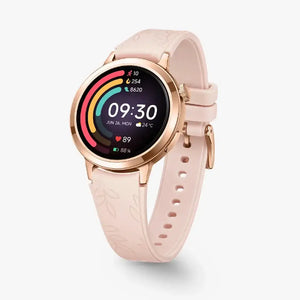
The silicone version of the FANY Luna is 29.2 grams and has a case diameter of 37.5 mm. Its compact case and relatively lightweight design may be very practical for users who wish to wear the same smartwatch for both daytime activities and nighttime monitoring. Consistent wear allows users to view data such as heart rate, sleep, activity, and workout as part of a broader routine, rather than as isolated measurements.

If, for example, a person works at a computer all day and then does Pilates or yoga in the evenings, they can use the data on their steps and activities to determine how much exercise they get during working hours. They can then review their heart rate and workout information. They can review sleep data the next morning to compare trends in sleep stages and duration.
FANY Luna is compatible with heart-rate monitoring, sleep tracking, and steps, calories, and workout tracking. It also supports 110+ workouts, including running, HIIT, Pilates, yoga, cycling, and strength training.
Women who are interested in wellness on a larger scale can also use FANY Luna, which includes tracking of emotions and stress, breathing meditation, and menstrual cycles. The app allows users to track sleep, activity, heart rates, and cycles within the contexts of their everyday lives.
The battery life can last up to 7 days (depending on usage and settings), which helps reduce the frequency of charging for the watch.
If you are looking for a smartwatch that can be worn every day, rather than just for workouts or fitness, then the FANY Luna is a good option to consider.
Who May Find FANY Luna a Good Fit?
Women who are interested in understanding their daily activity, sleep patterns, heart rates, and wellness trends, while caring about lightweight design, everyday style, and comfort, may find FANY Luna to be the perfect fit.
This is especially useful for those users who:
- Tracking your daily activity and fitness
- Sleep and heart rate trends awareness
- Women's Wellness Features
- The lightweight smartwatch is perfect for everyday use
- Multi-mode workouts without focusing on only professional sports data
FANY Luna may not be suitable for all users.
A more specialized device is a better option if you require professional-level recovery analytics or medical-grade monitoring. GPS performance tools are also available.
Wearable data for consumers is intended to help users become more aware of their daily patterns. It is not intended to replace professional medical diagnosis, treatment, or advice.
FAQ
1. What is a normal resting heart rate?
Resting heart rates for many adults are typically between 60 and 100 BPM. The target heart rate during exercise depends on your age and intensity. Exercise that is moderate is usually between 50%-70% estimated maximum heart rates, whereas vigorous exercise is typically 70%-85%.
2. What do Deep Sleep, Light Sleep, REM, and Awake Time mean on a smartwatch?
Deep, light, and REM are sleep stages estimated. Deep sleep is deeper NREM sleep. Light sleep is a lighter stage of sleep. REM stands for rapid eye movements. Smartwatch sleep data can be used for trend analysis over time, rather than medical measurements.
3. What is the difference between a smartwatch and a fitness tracker?
Both categories overlap. A fitness tracker is usually more focused on workout and activity tracking. Smartwatches often include notifications, calendar features, and other everyday functions.
4. What should I look for in a smartwatch for everyday wellness tracking?
Compare FANY Luna if your primary concerns are sleep, heart rate, stress, cycle tracker, fitness tracker, and comfort for everyday use. If you need medical-grade monitoring or professional sports analytics, a more specialized product may be better for you.
5. Are smartwatch health readings accurate?
Smartwatch readings can be useful for tracking everyday trends, but accuracy may vary depending on the sensor, fit, movement, and activity.
6. Should I worry about one unusual smartwatch reading?
Not necessarily. One unusual reading may be temporary. Look for repeated patterns, and consult a healthcare professional if you have concerning symptoms.
 Sia Cooper

A nurse-turned-personal trainer and founder of Diary of a Fit Mom, Sia lost 45 lbs through clean eating and lifestyle changes—and has been helping women do the same ever since. Drawing on her own journey through pregnancy, motherhood, and IVF, she's passionate about making fitness feel approachable, realistic, and empowering for women at every stage of life. Your trainer and friend.